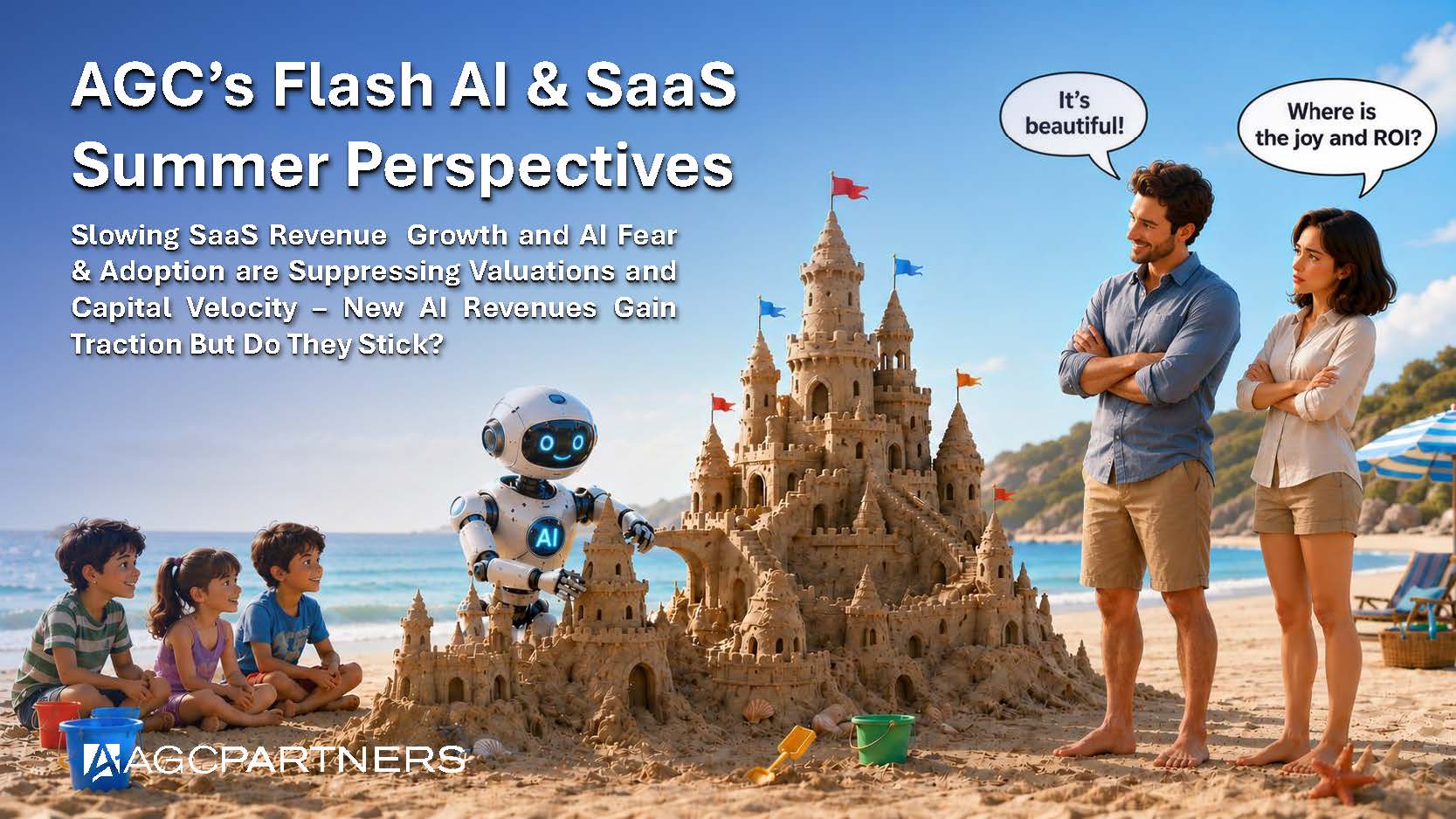
Fear of AI displacing SaaS solutions has crushed public SaaS valuations, which are down 33% in the last 5 months. Less talked about, but as important as AI, is the four-year sectoral slowdown in SaaS growth and underperformance on profitability. 45 years of harvesting new greenfields has naturally reduced software's growth opportunity. The fear of AI has been the catalyst, but the massive slowdown in SaaS revenue growth from mid-20s to 11% has had a crushing impact on investors' future growth prospects, exit multiples, returns, and ultimately valuations.
Sadly, SaaS revenue growth is under attack from a nemesis as dangerous as market maturation and that is seat attrition! SaaS companies across the land, big and small, are experiencing contraction rather than expansion upon renewals. There are several forces at work contributing to this powerful trend:
• Massive stimulus and FOMO in COVID drove overbuying of technology
• The current global employment recession where unemployment is low, but few are hiring and layoffs are broad based and getting larger and louder (case in point: Block)
• AI is freezing would-be buyers, reducing software purchases by reducing headcount (potential shift to outcome-based pricing), and causing customers to hold off new purchases, waiting for better and cheaper solutions with reduced switching costs
• Software can be expensive, and if it is not adding real value or mission critical, it gets churned
As a result of the selloff, the spread between public and private SaaS valuations, as marked by the GPs, has never been wider. Public small cap SaaS companies are currently trading at 9.6x '26 EBITDA and 2.3x '26 Revenue. The enormous spread between buyers and sellers in the private SaaS market, along with the unknown impact of AI, continues to dampen SaaS M&A velocity – SaaS M&A volumes and valuations in the first two months of '26 are at a 10-year low. AI M&A deal value and volume have been rapidly growing since 2022, while SaaS stagnates, and we anticipate 2026 will see an acceleration of this trend.
SaaS M&A has entered a winter that increasingly appears structural rather than cyclical, with deal value down 77% from the 2021 peak and volumes falling as buyers in an AI-first world reassess long-term credibility and durability of growth rates and profit margins. Constricting debt markets will reduce equity returns, limiting valuations and deal velocity particularly in the largest SaaS private and public deals. Blue Owl is not alone; lenders across the market are hitting hard times and pulling back on new loans. Virtually all classes of debt providers have pulled back and are offering less for more, if anything at all.
SaaS incumbents that are best positioned in an AI-driven world tend to share several core characteristics:
• Proprietary data
• Deep domain expertise built over years
• Strong customer relationships and embedded workflows
• Regulatory lock-in
• High product complexity and meaningful IP
These traits generate significant intrinsic value and together form a moat to prevent cannibalization from AI startups. However, public and private SaaS companies cannot rely solely on legacy moats to protect them, they must also actively re-invent elements of their operating models and product strategies for the AI era. SaaS incumbents that move early can increase switching costs, deepen customer dependency, and accelerate product velocity. Those that hesitate risk being leapfrogged by more agile AI-native competitors.
Some things remain unchanged: investors continue to price underlying company performance, with growth remaining the #1 metric of discrimination – SaaS companies growing at 10% trade at 10.1x EBITDA vs. 19.1x for 20% growers, and there are not many 30% growers. Meanwhile, AI is reinforcing the large-cap advantage – companies with market cap >$10B trade at 5.8x revenue and 13.8x EBITDA vs 2.3x revenue and 9.5x EBITDA for small caps. Vertical SaaS trades at a de minimis premium versus horizontal SaaS, despite similar profitability and potentially higher defensibility against AI risk.
The smaller end of the SaaS market, those companies under $100M in ARR, are still finding greenfields to exploit, generating oversized growth rates well in excess of the 11% by the bigs. These smaller, growth companies coming to the market have been achieving spot ARR multiples of 10-15x. While they will continue to receive premium multiples, they will be 20-30% lower than they were previously.
Traditional SaaS IPOs are dead for the time being. Any life in the IPO market will likely come from pure AI or AI-enhanced SaaS stories delivering large-scale, uber growth, and a believable path to profitability – or one or more of the foundation models will go public. DPI for SaaS companies is going to have to come from sales predominantly to PEs and secondarily to public strategics. CVs will continue but their star may start to fade when the eventual exit valuations are not as promised.
Tech PE land continues to raise larger funds from premier LPs, pushing dry powder to record highs. On the assumption that these funds will be deployed and not returned to LPs ☺, then we have abundant firepower for years to come for private and public acquisitions of both SaaS and AI companies. Unlike the public market, the private market is holding on to historical valuation marks despite much lower growth and the competitive implications of AI. The rapid and massive 33% reset for public market SaaS companies, which have superior scale and Rule of 40 performance compared to the private market, will now require significant markdowns across private portfolios. Once valuations are marked to realistic levels, the gap between the public and private market valuations will narrow, as will the valuation gap between buyers and sellers. At that point, the business of investing new capital and returning capital to LPs can begin to thrive again, though we may not see that pick-up in M&A velocity until 2027.
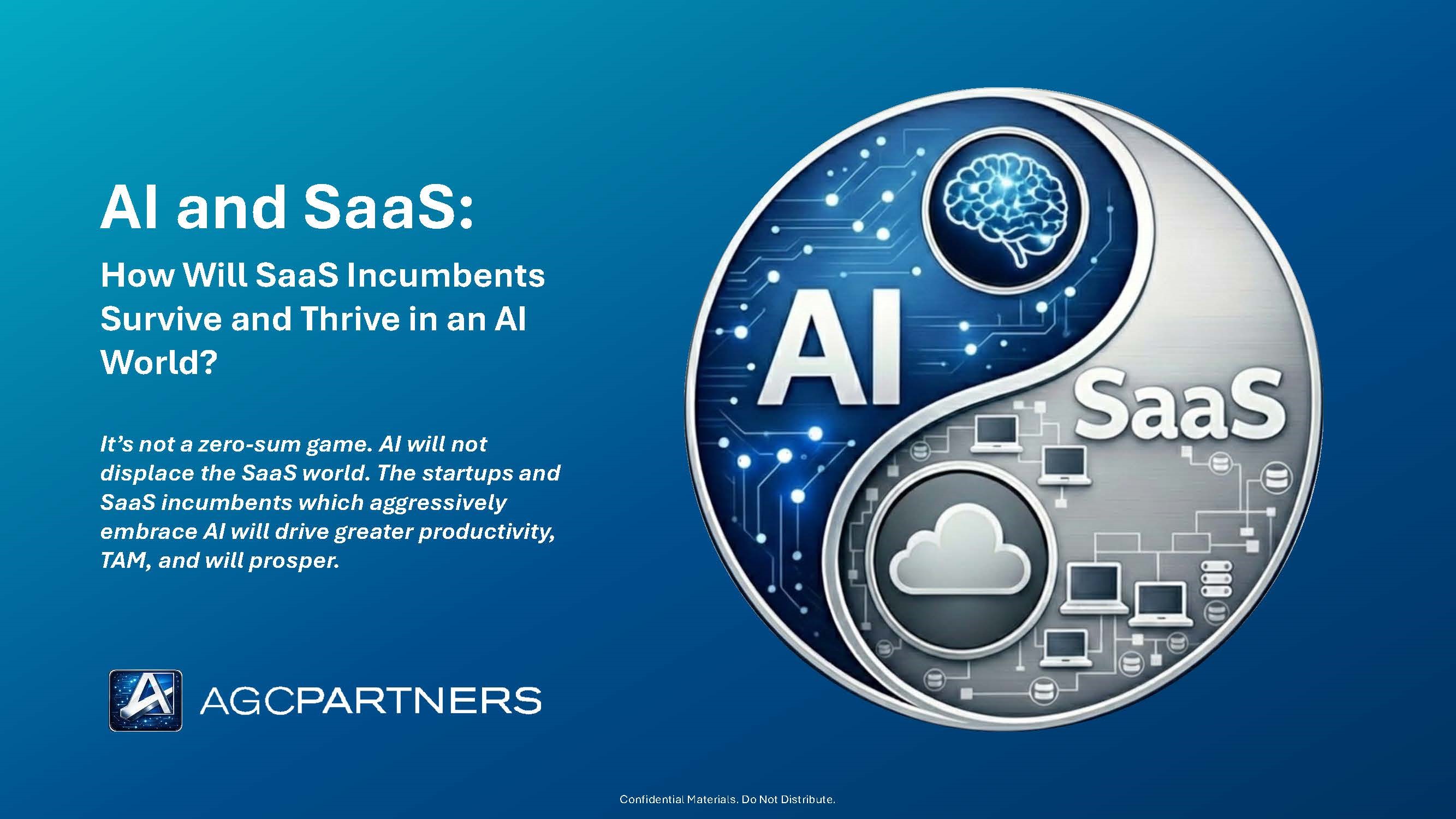
While the software world has been hit hard, its history of adapting and thriving during periods of change is well documented (e.g., mobile computing, the internet, and cloud computing). The unequivocal silver lining in this carnage is that AI and SaaS are like yin and yang – together they are creating powerful new applications that are already expanding TAM and will set the stage for a new M&A cycle.
Where is the Capital Going?
SaaS incumbents and PEs need to take an AI first mentality to survive and thrive in a world experiencing an AI tsunami. Since the AI revolution took deep roots in 2022, the five AI leaders have grown from $5T to $15T in market cap, that is roughly 25% of the S&P 500. In that time, SaaS companies have only grown from $2.5T to $3.3T.
In 2025 the same AI titans invested $400B, VCs $102B, and PEs invested less than $5B. PEs have taken a wait and see approach believing the bubble will pop and they will reassess then. Yes, AI is experiencing a massive bubble, but the post bubble AI world is very real and will impact every element of SaaS and the world we work and live in for good and bad!
Concentration of power in governments, big business, or capital markets almost always has bad endings for the people at large. Power tends to corrupt and absolute power corrupts absolutely(1). The SaaS world has thrived over 40 years with massive new company formation, unending innovation, and a relatively broad distribution of wealth for those risk-taking entrepreneurs and investors. Over the last 10 years, social media, e-commerce, mobile communication, and now AI, have driven massive concentration of market share and power. Google – search; Apple – mobile phones, Amazon – cloud/ecommerce, Facebook – social media, Microsoft – office & cloud; and now Open AI, Anthropic, and a few others owning the foundation model market. The Tech Titans now dominate these mega markets. If one or two foundation models control AI and the largest applications, then the world of innovation and startups will suffer. Customer pricing will rise, as will profits. The AI companies will become giants, and economic power will become highly concentrated.
(1): Lord Acton, 1887
The proliferation of AI across the globe will clearly create great benefits in all types of efficiencies and predictive values, such as environmental threats, cancer, etcetera. When AI is bringing some of the best knowledge to bear to any task or challenge, it is obviously going to create massive leverage in doing whatever mankind is trying to do. That said, we already know AI is not going to be all good news. As we are already seeing, the efficiencies generated by AI and AI agents are and will replace hundreds of millions of global workers. That displacement, which has already started, will have painful consequences for mankind. As we jump into the AI world full steam ahead, we need to be highly vigilant, humane, and balanced in the application and speed in which we embrace the power of AI.
AGC Partners is AI first. We have 36 active engagements, 29 of which are AI companies. Having closed 560 deals over 23 years, we are well positioned to understand and articulate tectonic shifts and the way forward.

© In the U.S., America’s Growth Capital, LLC dba AGC Partners, member FINRA/SIPC. In Europe, America’s Growth Capital Europe, LLP (Appointed Representative Alternatives St. James, LLP which is authorized and regulated by the Financial Conduct Authority). America’s Growth Capital Europe, LLP is a Limited Liability Partnership incorporated in England and Wales (OC368580). Its registered address is 6th Floor, 9 Appold Street, London EC2A 2AP. The testimonials contained herein may not be representative of the experience of other customers or clients. Testimonials are no guarantee of future performance or success. Deals marked with an “*” are non-AGC deals.