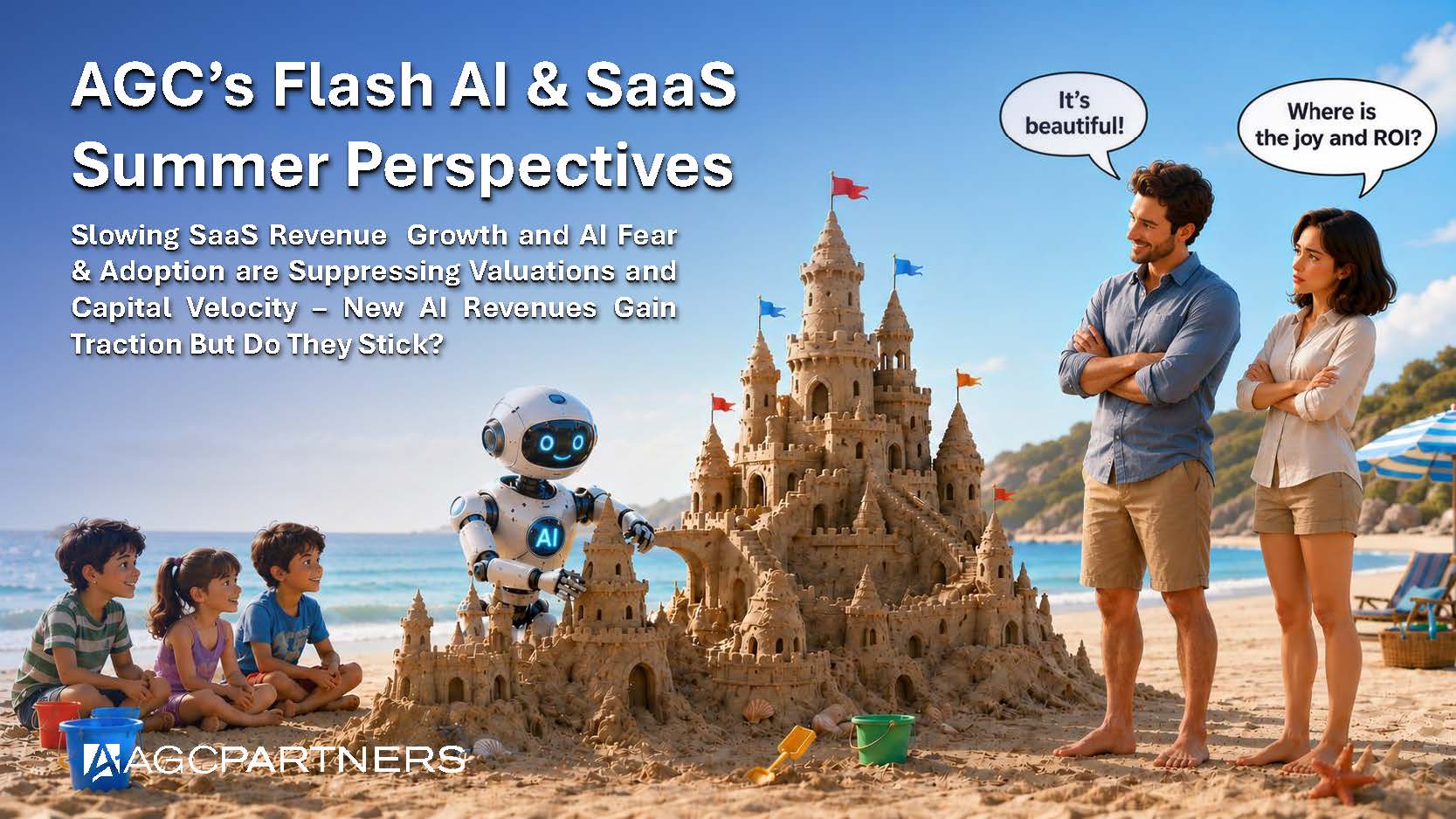
Global tech M&A is down 60% in the first four months of 2026 from $300B annualized transaction volume to a lowly $135B. The fear of AI and slowdown of SaaS revenue growth have valuations down 30% and deal activity at a 12-year low. No one has been spared in this downdraft, including AGC Partners. Yet even in the most challenging market of our history, we have signed a record number of new engagements in 2026 – a clear signal that demand for trusted, experienced advisors intensifies precisely when markets get hard. Global capital flows are often driven by FOMO and groupthink allocations that overweight asset classes regardless of the fundamentals. Investors went too big for too long into software and are now bolting from it in pursuit of AI. Software is oversold and AI – as big as it will become – is a bubble with lots of promises likely to be unfulfilled ahead. This rapid and almost violent shift from traditional software to an AI-powered world has all of us in the eye of the storm. As banged up and bruised as some of us are, now may be the greatest opportunity of our lifetime.
Google, Microsoft, Amazon, and Nvidia along with OpenAI, SpaceX, and Anthropic are rapidly and privately funding the most powerful AI models with trillions of their own capital. Funds are also flowing into early-stage frontier AI labs exploring alternative approaches to large language model pretraining – such as Ineffable's record seed round led by Sequoia with participation from Nvidia and Google, which is building a reinforcement "superlearner" system that learns entirely from its own experience rather than from human-generated datasets. This reflects a broader shift where the brightest minds and largest pools of capital are not only scaling today's dominant model architectures but also underwriting multiple competing hypotheses for how general intelligence systems may ultimately be built.
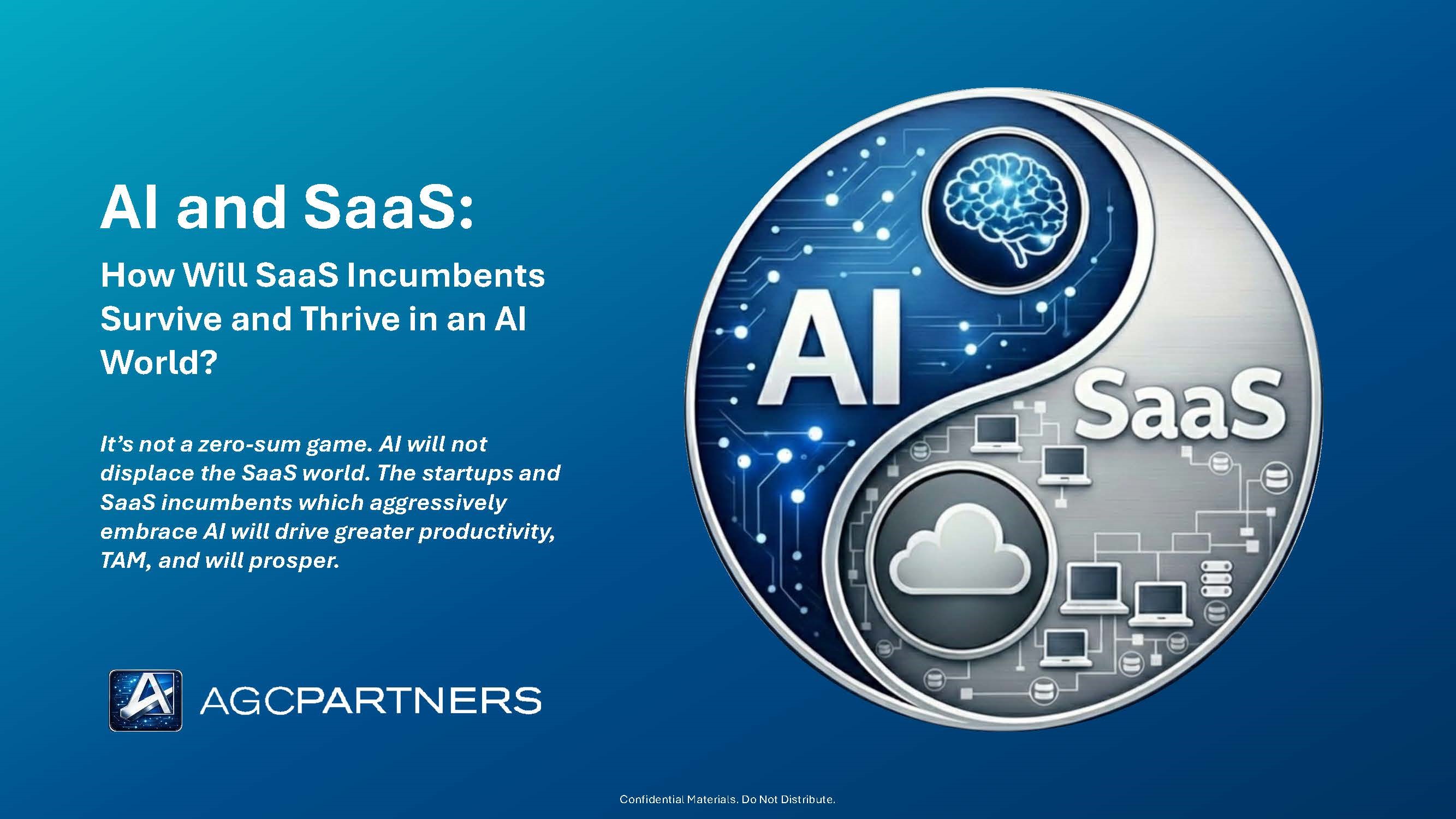
Rather than one or two dominant LLMs taking over the world, there will be an oligopoly of superpowered models including a good enough, low-cost open-weight/open-source model that creates a highly competitive and commoditized LLM world. We have seen this story repeat itself before at various technology inflection points: internet → ISPs, cloud → cloud service vendors. In these scenarios, the bigs do not crush the smalls – they coexist, suggesting our egalitarian and innovative AI & SaaS world will survive and thrive. The incumbent SaaS providers across the world have the pole position and most will maintain their lead through customer success, operating leaner, and embracing AI – particularly those sitting on years of clean, structured, proprietary data that new AI entrants simply cannot replicate.
We just held our London AI and SaaS Summit with 175 companies from 25 countries, marking a historic high in both companies presenting and meetings held – 1,500. The buzz was contagious in part because we are starting to see small companies take off from the power of AI. SaaS growth has been slowing for four years due to oversaturation but there are now signs of light from this storm of AI we have been struggling through. Entrepreneurs and CEOs have started 36,000 AI companies in recent years. PEs hold close to 10,000 companies on a control and non-control basis. These PEs have $500B in dry powder that now must pivot to AI/SaaS stories. AI now allows tech entrepreneurs and investors to expand their impact on a business from the current 5% of the budget to more than 10% – or $3T to $6T of TAM. Case in point – General Catalyst & Thrive Capital-backed AI services roll-up, Long Lake, agreed to acquire American Express' travel services business for $6.3B, a clear signal that AI-enabled operators are moving beyond software and into large, traditional service businesses that were previously outside tech's reach. We are in the first inning of this incredible and unpredictable game with lots of opportunity ahead. Maybe as a sign of things to come, AGC has closed 2 deals this week and signed 20 engagements in 2026 YTD – a new record.
Global PE Funds bought 72% of the software companies at scale that transacted in 2025. These same funds have pulled back on platform and add-on acquisitions by 33% in first 4 months of 2026. The traditional SaaS software market has long been dominated by the PE world, so this current PE pause in activity is crushing transaction velocity. Public strategic buyers have represented only 28% of the buying market primarily because: i) they are more selective and discriminating buyers; ii) they have not been willing to match PEs in valuation; and iii) they are more committed to internal development and AI. The strategics are known to do very large transformation transactions like Google buying Wiz, and very small acqui-hires. They are far less active in the middle-market.
The 30% fall in public and private values and the preoccupation with AI has most strategics and PEs focusing internally and not externally on acquisitions. This pause could be long or quite short – it's hard to say. What is certain is that PEs need to sell companies to deliver investors cash and real returns and strategics need to buy companies to stay competitive going forward. Valuations will be much lower for a broad swath of companies while the elite AI-native performers will continue to capture stratospheric valuations. The table is set for robust PE and strategic M&A once the players jump back in the game.
We have awoken to a new dawn in the software world. The 45-year run of supercharged 25%+ revenue growth, massive global innovation, a $3T private equity industry and hundreds of billionaires, is now facing the conundrum of both old age and the threat and opportunity of a new era of technology – AI. The big difference in this tectonic technology shift is that the faster, better, cheaper youngsters come in the form of 36,000 AI startups and four enormous and massively capitalized LLMs.
This is just the beginning of a brave new world of opportunity for those eager to embrace these new challenges and powerful technologies to take advantage of doors left open by the slower-moving incumbents. One of my 60-year-old CEOs just took an AI immersion course at MIT to better lead his native AI EdTech company. Virtually the entire global software spend of ~$3.6T is under the microscope with a new AI lens. Every business across the world, big and small, is experimenting with AI trying to improve its game – or should be!
This transition to an AI world has already wreaked havoc on the status quo SaaS world and will continue to do so. The promise of faster, better, cheaper SaaS/AI offerings is compressing pricing, freezing new orders, crushing valuations and redirecting capital flows from old-school SaaS to AI. Beyond the fall in M&A activity, AGC's SaaS Index fell 30% in 6 months and '26 revenue growth rates are down to 10%. The top 250 Tech PE funds raised $170B in all of 2025 and OpenAI, Anthropic, and xAI raised $212B in '26 YTD. Tech PEs bought only 216 companies in Q1 '26 versus 394 in Q1 '22. The SaaS world has changed forever.
This new world offers incumbents, startups, and LLMs the opportunity to bring their enhanced game to businesses and consumers across the world. In many cases these tech customers will over rotate to new AI solutions that do not work. The churn metrics of many of the well-funded native AI start-ups are not pretty. Whether you are building and selling tech or using it to run your business, you need to test the current boundaries of AI because doing what we did before unchallenged is likely to result in failure. We all need to learn what AI can do for us as fast as we can, leverage what works, and quickly discard what does not!
Valuations for the 107 public SaaS companies below $10B in EV are now trading at 11x '26 EBITDA and 2.5x revenue. These public comparables to the private sector are growing at 9% with a 32% rule of 40. As I have said before, the public SaaS market was oversold and is now coming back. The calculation for these valuations can be complicated and at times, emotional. Growth, retention, profits, moats, and many other factors contribute to a wide range of values – so not all SaaS companies should be valued at 11x EBITDA. That said, the old 30x EBITDA on larger SaaS companies is closer to 20x now and the old 10x earlier stage SaaS is now 7x. AGC sold 28 companies last year, 14 of which were platforms sold at a median 8.5x spot ARR so we have a good feel for valuations. Selling SaaS companies today requires an extremely thoughtful AI game plan and a 10-year financial model – 5 years for the current buyer and 5 more years for the next buyer ☺.
The tech M&A market was body slammed in Q1 but we will get back up and see a renaissance of deal making made up of both legacy SaaS companies and new AI entrants. There are ~4,600 PE-owned tech companies and PEs are selling only 150 to 200 per year. That number should be closer to 600 per year. There are ~40,000 tech VC-backed companies of scale. With only 15 Tech IPOs per year, most of these companies will be looking to sell. In just the last 10 years, ~36,000 AI companies have been started. 2026 will be a tough year for most of us in the SaaS world but the sun will shine again in 2027.
We are all in bottoms up self-evaluation mode and many are taking rapid action in 2026. Are my customers happy? How is my gross and net retention? Should I rebuild my product as native AI? Can I compete in the agentic world? How is my corporate efficiency and are we properly utilizing AI to create efficiencies and better serve our clients? Is my current growth rate my long-term growth rate? What are my stock options and company worth? "Should I Stay or Should I Go?" (The Clash, '82) to a new opportunity with lots of upside and less baggage? The current set of challenges and opportunities makes one thing perfectly clear, status quo is not an option.
The elephant in the room is when, how, at what value, and to whom will GPs start selling the ~4,600 tech companies in their portfolios. Small Cap Public SaaS has been adjusted down by 37% for slower growth and AI risk. How far will the $3.0T in private valuation markers fall? The answer in part will depend on how thoughtfully PEs reposition their portfolios through an AI lens – and just as no two SaaS companies are valued the same, the AI game plan needs to be highly customized for each. That may mean deprioritizing non-mission-critical assets where commoditization risk is most acute, while increasing focus on companies with proprietary data, core operational depth, and regulatory lock-in. One view is that the strongest portfolio companies will be those that leverage what new entrants simply cannot replicate overnight: years of proprietary transactional data, deeply embedded workflows, and institutional domain expertise. The companies best positioned aren't necessarily the ones born AI-native, but those that are actively deploying AI across existing data assets – gradually transforming platforms into intelligent systems that can drive measurable customer outcomes, support agentic workflows, and deepen retention.
AGC Partners' deep AI and subsector knowledge, highly active live deal experience, and strong PE and strategic relationships empower our Partners to be exceptional advisors for CEOs trying to chart a course through these challenging waters. Whether the technology is AI, Cyber, GRC, or one of 50 verticals, the AGC advisory team is deep in knowledge and relationships, ready to go 24/7, and able to power through those bumps in the road to bring about great outcomes.

© In the U.S., America’s Growth Capital, LLC dba AGC Partners, member FINRA/SIPC. In Europe, America’s Growth Capital Europe, LLP (Appointed Representative Alternatives St. James, LLP which is authorized and regulated by the Financial Conduct Authority). America’s Growth Capital Europe, LLP is a Limited Liability Partnership incorporated in England and Wales (OC368580). Its registered address is 6th Floor, 9 Appold Street, London EC2A 2AP. The testimonials contained herein may not be representative of the experience of other customers or clients. Testimonials are no guarantee of future performance or success. Deals marked with an “*” are non-AGC deals.